Showing posts with label caffeine. Show all posts

Monday, February 17, 2014

Caffeine in Beverages

Since its been shown that caffeine can increase blood glucose and make cells more resistant to insulin after a meal, I thought it would be helpful to post the caffeine content of some common beverages and chocolate.

Click the link to the right for a table distributed by the American Beverage Association. It lists the caffeine content of drinks manufactured by several companies, including Coca-Cola, Pepsi, Royal Crown, and Snapple.

Note that energy drinks (8.4 oz. can) typically contain the amount of caffeine found in a cup of coffee. Some not listed:
  • Impulse - 88 mg.
  • Naughty Boy - 80 mg.
  • Red Bull - 80 mg.
  • V - 78 mg.
Click here for a table compiled by Kansas State Universitys Research and Extension Program. It lists the approximate caffeine content of some common coffee and tea beverages, and chocolate.

Note that the caffeine values for coffee and tea apply to 5 oz. servings. A coffee mug typically holds 8 oz. Take-out cups can be 16 oz. or more.

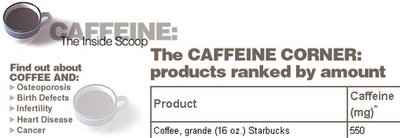
Speaking of take-out coffee, about 10 years ago, the Center for Science in the Public Interest (CSPI) published the table below which drew attention to the caffeine content of Starbucks brewed coffees:


Starbucks doesnt divulge caffeine content on their website. But an article from Newhouse News Service (NNS) in 2003 reported finding "anywhere from 259 to 564 milligrams of caffeine" in 16 oz. Starbucks samples. They contacted a Starbucks rep:
"Lara Wyss, spokeswoman for the Seattle-based Starbucks Coffee Co., said in a statement that "many variables contribute to caffeine levels in coffee from cup to cup," including type of bean, roast, brewing method, grind and coffee maker. Starbucks customers can expect an average of 200 milligrams of caffeine per 8 ounces, she added."

That equates to 300 mg. caffeine for a Starbucks 12 oz. "tall", and 400 mg. for a 16 oz. "grande". Quite a jolt.

Tuesday, October 15, 2013

Ways of Reducing Caffeine Addiction

Ways of Reducing Caffeine Addiction | Theres nothing wrong with caffeine, until you drink too much, so suffer from heartburn and difficulty sleeping. If you are too worried about the possible adverse effects of caffeine in the long run, try to minimize it.

Reducing caffeine can reduce the complaints of heartburn (acid reflux), sleep disturbances, and anxiety. But stop caffeine altogether can make you more irritable, fatigue, even headaches. For that, follow these safety tips to reduce caffeine, such as those delivered by Robynne Chutkan, an expert in gastroenterology at the University Medical Center.

1. Reduce slowly

If you are a heavy drinker of caffeine, then you need to cut back slowly, so that withdrawal symptoms can be reduced. Remember that caffeine can be obtained from many sources, including chocolate.

2. Find substitutes drink

As early perhaps you could replace the coffee with decaf coffee, the caffeine content is much less. Gradually replace coffee with free caffeine beverages.

3. Relieve headache

Headaches that lasted more than two days, could be a sign you are experiencing symptoms of caffeine addiction. When the headaches began to interfere, consume a headache reliever. But avoid aspirin or ibuprofen and choose asetaminopen because it does not cause heartburn.

4. Drink more water

Drinking more water is one way to do a detox. Also in the hydrated state, the body will be more vigilant so that the mind stay focused even without caffeine.

5. Sport

Exercise can have the effect of such stimulants, like caffeine. Therefore, if there are signs of caffeine addiction, such as fatigue, dizziness, do physical activity to boost energy.

6. Eat healthy foods

When during a mainstay of caffeine when you are busy, instead eat healthy foods, which not containing added sugar, and fast food. Healthy food is a good energy booster, especially carbohydrates derived from the fibers.

7. Consider the schedule

This means do not let the "tank" is empty of food for more than four hours. Are left empty stomach will make the body more energized and difficulty concentrating.

8. Get enough sleep

Coffee contains the stimulant, so if we stop eating we tend to feel less powerful. In fact, the most potent medicine to restore energy is sleep. To get around the difficulty sleeping, avoid naps, exercising regularly, and sleep at the same time every night.

May Ways of Reducing Caffeine Addiction be useful, you also interest in benefits of soy milk

Saturday, September 14, 2013

Caffeine in Green Tea Vs Coffee

Green Tea vs Coffee
Green Tea vs Coffee
Green Tea vs Coffee
Caffeine in Green Tea Vs Coffee  - When should choose coffee or green tea, usually the consideration is taste because they have proven equally healthy. Is there caffeine in green tea? absolutely YES! But equally as substance caffeine found in coffee green tea and coffee. Comparison of caffeine in green tea vs coffee debate. Here are reviews of caffeine in green tea vs coffee.

Which one is better? Caffeine in green tea or coffee?

1. When the need to boost stamina
Caffeine in coffee and green tea are equally able to boost stamina by increasing heart rate and blood pressure. The only difference being levels, in each 200 mL of green tea contains an average of 14-16 mg of caffeine in 200 mL of coffee while caffeine content can reach an average of 95 mL.

Recommendations caffeine in green tea vs coffee: coffee, because caffeine content is higher so the effect is stronger and faster.

2. When the need is always healthy
A 2009 study showed that drinking four cups of coffee per day can reduce the risk of type-2 diabetes by 30 percent. Other studies have shown. Drink at least 3 cups of coffee per day can reduce the risk of skin cancer by 9 percent.

However, long-term benefits from drinking green tea every day also has many proven especially green tea. The content of antioxidants in these drinks can strengthen the immune system, and the men are very effective in preventing prostate cancer.

Recommendations caffeine in green tea vs coffee: Both are equally healthy to be consumed every day.
Caffeine in Green Tea Vs Coffee

 Caffeine in Green Tea Vs Coffee

3. When the need to lose weight
In general, caffeine has been shown to lower body weight and waist circumference. But specifically, a study in the American Journal of Clinical Nutrition proved that drinking green tea every day effectively shrinks the stomach as much as 3.4 cm in 12 weeks only.

Recommendations caffeine in green tea vs coffee: Green tea, because the effect in burning fat faster and make more efficient the cells metabolism.

4. When it took a muscular body
If green tea is more effective to burn fat, then copy the most effective form of muscle mass due to the higher caffeine content makes stimulus stronger effect. When someone, especially men drink 2.5 cups of coffee before exercise, then he can do a sprint or sprint 9 percent farther.

Recommendations caffeine in green tea vs coffee: Coffee, because muscle stimulation needed to work harder. The more commonly used for heavy work, the muscle mass will grow.
caffeine content in green tea vs coffee

 caffeine content in green tea vs coffee

5. When the need to improve mood
Unlike coffee that often makes the heart pounding because high levels of caffeine, green tea is more suitable to relieve tension on the nerves. Even according to the European Journal of Applied Physiology, several types of green tea such as chamomile and lavender green tea can relieve stress and feelings of anxiety just by smell alone kissed.

Recommendations caffeine in green tea vs coffee: Green tea, because tradition in many countries such as Japan and China have also proved that the drink is best suited to complement a relaxing time.